 Sicily Mount Etna Tours
What to Wear on Mount Etna
What to wear on Mount Etna is a layer question, not a brand question. The drive from Catania can start at 28C on the coast and end an hour later in an 8C wind at 2,000 metres, and the crater zone above the cable car is colder again. This guide gives the exact stack that works in every season: stiff shoes for lava ground, a windproof shell that packs small, sun and dust protection for the reflective black slopes, and the small extras, gloves in summer, gaiters after snow, that decide comfort. The same rule shapes the tours in the Mount Etna tours compared side by side on the homepage: the higher the route goes, the more the volcano punishes wrong clothes.
Quick answer Layers plus stiff shoes, windproof shell, sunglasses, and gloves even in summer
Dress in layers over closed walking shoes: a breathable base, a warm mid layer and a windproof shell. The temperature falls from 28C in Catania to about 8C at 2,000 m on the same afternoon, and the summit zone is colder and almost always windy. Bring sunglasses, sunscreen and water, because lava reflects sun and raises dust. Guided summit routes supply boots, jackets and helmets if you do not own them, and lava-cave stops supply helmets and torches. Check the forecast for Rifugio Sapienza or Piano Provenzana, not for Catania, the evening before you go.
Key takeaways
- The cable-car day reaches 2,500 m, where the cable-car guide explains the costs, so pack as much for wind as for cold
- Stiff soles matter more than waterproofing on dry lava, and the morning jeep loop stays on ground where trainers survive
- For month-by-month conditions, see when to visit Mount Etna
The Short Answer
Wear closed walking shoes, long trousers and two warm layers topped by a windproof shell, and carry sunglasses, sunscreen and water in a small pack. That stack works in every month of the year on Etna, because the volcano runs its own climate: the coast can swim in 28C while the slopes hold an 8C wind, and the crater zone above the cable-car station adds wind chill on top. In winter the same stack gains a heavier coat, gloves and a hat, and the ground itself changes under snow.
The one addition worth stating up front: check the mountain's own forecast the evening before, not Catania's, and let the wind reading pick your outer layer for you. Everything else in this guide is detail around that habit. One line of law matters for packing decisions too: above roughly 2,900 metres only certified guides may walk, and that high ground is where the warmest layers and the issued gear earn their keep.
Why the Volcano Punishes Wrong Clothes
Etna's height is the whole story. The trailheads sit at about 1,920 m on the south side and about 1,810 m on the north, and temperature falls roughly one degree for every 100 m you climb, so a beach morning turns into a cold walk before the first crater. Wind does the rest: the upper slopes carry almost no vegetation to break it, and the cable-car station at 2,500 m is exposed from every side.
The ground adds its own rules. Fresh lava field is sharp, abrasive and dusty, and black basalt absorbs and re-radiates sun so strongly that exposed skin burns on overcast days. Lava dust works its way into cheap trainers and open mesh, which is why footwear is the one item worth buying properly.
Forecasts mislead if you read the wrong town. Reliability drops beyond about three days, and the forecast points that matter are Rifugio Sapienza, Crateri Silvestri and Torre del Filosofo on the south side, Piano Provenzana and Pizzi Deneri on the north. Catania's forecast says almost nothing about the crater zone.
Footwear: The One Non-Negotiable
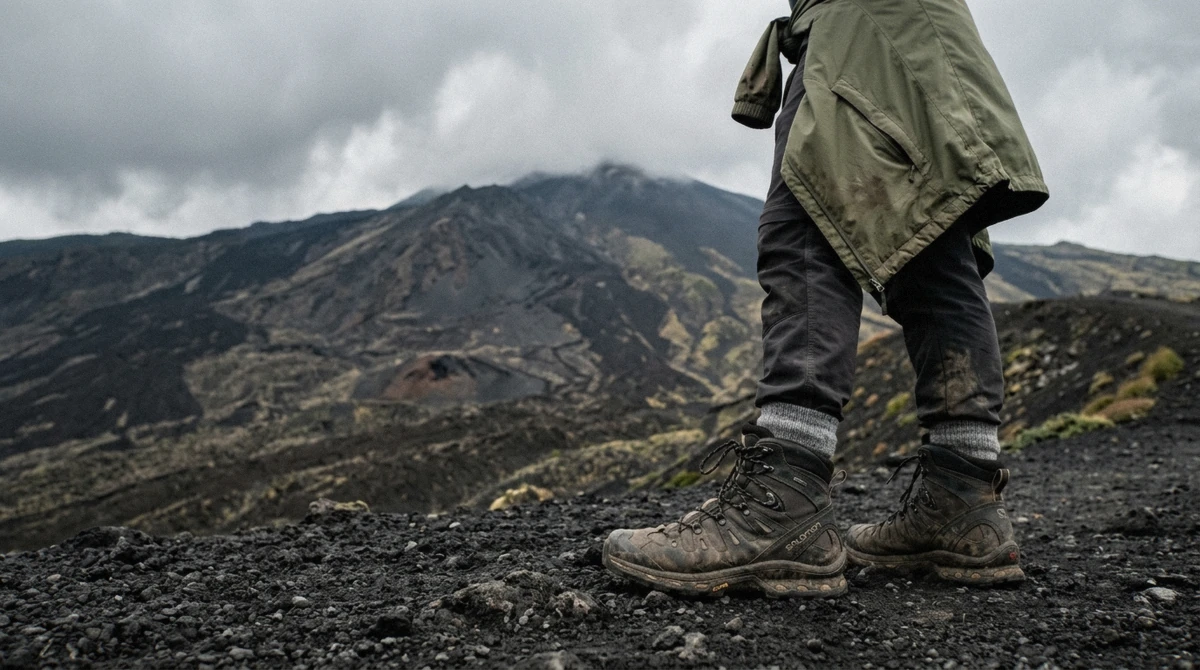
Stiff soles and covered toes are the minimum on any route above the car parks. Volcanic gravel rolls underfoot, and the gritty surface eats soft fabric shoes within a morning. Hiking boots with ankle support are the honest answer for crater walks and any guided lava-field route, and thick socks matter as much as the boots, because thin socks transfer every sharp edge straight to the foot.
The exception is the paved lookout circuit at the top of the Sapienza road, where the Silvestri craters sit on graded paths and stiff trainers survive a dry day. Every tour that leaves those paths, and every summit route, assumes boots. The summit cable-car excursion supplies socks, shoes, jackets and helmets precisely because most travellers arrive without them.
The Layer System That Works
Three layers cover the whole year: a breathable base against the skin, a warm mid layer such as a fleece, and a windproof shell that folds into nothing. The shell is the piece people skip and then buy at the mountain, because wind, not cold, is what ends summit days early. Long trousers beat shorts on lava ground regardless of season.
Carry the spare shirt in the pack. Guides on full-day routes point out that a soaked base layer chills fast the moment the group stops moving, and a dry swap at the cable-car station resets the afternoon. Gloves and a hat follow the shell up the altitude ladder: even in July, hands freeze on the walk from the 4x4 drop to the crater rim.
One comparison makes the system concrete. The crater-zone walk on the half-day tours keeps most travellers comfortable with the three-layer stack, while the full summit routes cross snow patches most of the year and reward anyone wearing proper mountain layers. The tours in the catalog are compared on exactly that altitude gap, and you can compare all Mount Etna tours side by side before choosing how cold you want to get.
Sun, Dust and Eyes: The Overlooked Half
Sunglasses are safety equipment on Etna, not fashion. The summit zone throws reflected light off black basalt from every angle, and fine volcanic dust rides any breeze, so wraparound styles earn their keep. Sunscreen goes on before the drive and again at the cable-car station, because the burn happens fast at altitude even when the air feels cold.
Water is part of dressing. Dry volcanic air and wind dehydrate walkers faster than coastal heat, and there is nowhere to buy water above the car parks. A litre per half day is the working minimum, more on summit routes, and the listings in this comparison all state what food and drink you carry yourself.
Summer List Versus Winter List
The two lists side by side: the summer stack stays light and trusts the shell, the winter stack adds insulation and traction. Everything else, sunglasses, sunscreen, water, cash, belongs in both packs.
| Item | Summer list | Winter list |
|---|---|---|
| Footwear | Stiff walking shoes or boots, thin technical socks | Insulated boots, heavy socks, gaiters in deep snow |
| Layers | T-shirt, fleece, windproof shell | Thermal base, heavy fleece, insulated coat, windproof shell |
| Head and hands | Sun hat, sunglasses, gloves for the summit zone | Warm hat, sealed sunglasses or goggles, insulated gloves |
| Extras | Sunscreen, one litre of water | Rain shell, traction devices after storms, thermos |
| Ground | Ash and gravel paths, dry | Snow and ice above the cable-car line |
The summer list stays short: hiking shoes, long light trousers, t-shirt, fleece and windproof shell, hat, sunglasses, sunscreen, water. Days are long, the cable car runs its 4x4 bus connection, and the whole upper mountain is walkable when the volcano allows it.
The winter list swaps the base for thermal fabric and adds a proper insulated coat, gloves, a warm hat and gaiters once snow lies on the slopes. The upper cable-car leg swaps its summer bus for a snowcat, the north side opens its ski slopes, and short days push everything earlier. Rain gear belongs in the pack from late autumn through spring on both lists.
- Closed walking shoes or boots, worn in, never new on the day
- Windproof shell, warm mid layer, long trousers
- Sunglasses, sunscreen, hat, gloves above 2,000 m in any season
- Water, one litre minimum per half day, plus small cash for on-site tickets
- Headwear that survives wind: a hat with a chin cord beats a cap
What the Tours Provide and What They Don't
Gear provision splits cleanly in this catalog. The summit cable-car excursion supplies socks, shoes, jackets and helmets, which makes it the right pick for anyone travelling light. The guided treks and the lava-cave stops supply helmets and torches where the route needs them.
Everything else, warm layers, sun protection, water and food, is the traveller's own kit on every listing, and the price sections on each tour page state the split exactly.
The guide on what the sunset day includes shows the pattern: helmets and torches provided for the cave, tasting included at the farm, warm layer explicitly your problem. Read the inclusions before packing, because the difference between a provided jacket and a carried one is a checked bag.
If You Packed Wrong: Fixing It in Nicolosi or Catania
Nicolosi, the last town before the south-side road, keeps outdoor and souvenir shops that sell exactly the things people forget: windbreakers, hats, socks and sunglasses. Prices run above city rates, but the town exists because under-prepared visitors always have. Catania's commercial streets, a few minutes further back, do the same job cheaper the evening before a tour.
The cheapest fix is the earliest one: pack the shell and the shoes in the first place. Read the inclusions and the altitude of your chosen day before you fly, and the shopping trip disappears from the itinerary entirely.
Reading the Forecast Points Like a Local
The habit that separates comfortable Etna days from miserable ones is checking the mountain's own forecast points the evening before: Rifugio Sapienza for the south side, Piano Provenzana for the north, and the wind reading above all, because wind is what cancels cable cars and turns a 10C morning into a negative-feeling one. The Catania forecast flatters, the mountain forecast delivers.
Forecast reliability fades beyond about three days, so the working pattern is: dress for the season from the lists above, then adjust the outer layer the night before from the mountain reading. A packed shell weighs nothing; a wrong guess at 2,500 m weighs the rest of the day.
Dressing Kids for the Volcano
Children cool faster than adults and notice it less until they are miserable, so the kid version of the layer system runs one layer warmer: an extra fleece under the shell, a proper hat, and gloves above the cable-car station in any month. The lava gravel that rolls under adult boots doubles in height for a child, which is the honest reason the crater paths suit walkers who are steady on their feet.
The family-friendly listings in this comparison cap group sizes and hand out infant seats where the route allows them, and the family-shaped jeep morning stays on ground where the kid layer list works year-round. Snacks count as clothing at this altitude: a fed child is a warm child.
Cameras, Drones and Keeping Gear Working
Volcanic dust is fine, abrasive and everywhere on the upper routes, and it finds lens barrels and sensor chambers with enthusiasm. A zoom lens that stays capped between shots, a blower in the pack and a body swapped rather than a lens swapped in the wind are the working habits. Spare batteries ride warm, because the crater zone drains them faster than the coast ever will.
Drones have their own rule: much of the volcano's airspace is restricted, and the national park's rules plus safety zones around the craters make most consumer drone flying a bad idea without permits. The cable car's operators enforce on the platforms, and guides will stop a launch that endangers the group. Bring the telephoto instead; the craters photograph beautifully from the marked routes.
The Summit Kit: What Guided High Routes Demand
Above the cable-car line the kit list hardens: mountain boots with stiff soles, windproof trousers as well as the jacket, gloves rated for wind, sunglasses that seal, and a pack that leaves both hands free for the ash slopes. The guided summit excursion issues socks, shoes, jackets and helmets precisely because this list is a buy-a-bag list, and the guide's route choice at about 3,000 m depends on everyone in the group being dressed for it.
What the high routes add beyond gear is honesty about the body: the altitude is real, the air is thinner, and the walk from the 4x4 drop climbs steadily on volcanic sand. Anyone who can manage a long staircase with a pack can manage it dressed right, and anyone who cannot will wish they had booked the lower crater walks instead.
Rain, Mud and the Shoulder Months
Late autumn and spring rains turn the lower trails to greasy black clay, the kind that cakes boots and makes the first hundred metres a slip lecture. Waterproof shoes help the feet but the deeper fix is gaiters and trousers you do not mind sacrificing to the mud, plus a dry pair of socks waiting in the car.
Rain also rewrites the temperature math. A wet 12C at 1,900 m feels colder than a dry 5C, because evaporative chill strips heat from anyone dressed in cotton. The shell earns its place in the pack for rain as much as for wind, and synthetic or wool layers insulate when wet where cotton simply gives up.
The shoulder months also hide the season's best light: storm clouds over the crater, sun on the coast below, and the volcano photographed from the Silvestri paths with nobody else in the frame. Dress for the mud and the shoulder months pay you back in solitude.
What Guides Notice Before You Do
Talk to the guides who meet the morning vans and the same three wardrobe failures repeat: city sneakers with smooth soles on ash, cotton hoodies soaked with sweat by the first climb, and sunglasses left in the car because the sky looked grey from the coast. The guide's fix list is short, and every item costs less than the rental counter's version.
Guides also carry spares, and it is worth knowing what: the summit excursion's boot-and-jacket kit, helmet stashes at the lava caves, and a guide-sized first kit. What they never carry is enough water for a group that did not bring its own, and the walk down for more water is the day's only unforgivable mistake.
A One-Bag Packing List for the Volcano Day
Packed as one carry-on day bag, the whole list weighs under four kilograms: walking shoes worn, not carried, a shell folded to its pocket size, a fleece, long trousers already on, sunglasses, sunscreen stick, hat, gloves in the cold months, one litre of water, snacks, small cash, phone, and a dry shirt in a plastic bag for the ride home.
The bag itself matters less than its closure: zips over open tops, because volcanic dust is finer than beach sand and finds everything. Travellers who pack the night before, from this list rather than from memory, report the same small revelation: the volcano stops being a wardrobe problem and becomes just the day's plan.
- Shoes: stiff soles, covered toes, worn in
- Shell: windproof, rain-rated, pocket-sized
- Layers: base plus fleece, one more for children
- Head and hands: hat, sunglasses, gloves above 2,000 m
- Pack: one litre water, snacks, cash, dry shirt in a bag
Feet Second: Socks, Blister Kit and the Long Walk Home
Socks decide more volcano days than boots do. One technical pair, wool or synthetic, keeps grit out and blisters down, and a spare pair in the pack converts a wet morning into a survivable afternoon. Cotton socks on lava ground are the classic first-hour blister, and the blister plasters that live in the bag's side pocket are the cheapest insurance on the mountain.
Break the shoes in before the trip, not on it. A stiff new boot on a six-kilometre crater walk writes its review on your heels by the second kilometre. Guides spot the shiny new soles from the van, and the honest advice they give is the boring one: wear them around town for two days first, and carry the plasters anyway.
Hands, Head and the Small Comforts That Decide the Day
Extremities fail first on the volcano. Hands hold the wind on every crater path, and a pair of light gloves in July is less surprising at 2,500 m than it sounds, because the cable-car station's wind reads ten degrees colder than the car park below. A hat with a chin cord survives gusts that claim caps, and a buff doubles as dust filter, ear warmer and sun shield in one piece of fabric.
The small comforts multiply at altitude. Lip balm with sunblock, because the combination of wind and reflected light splits lips within an hour. A snack with salt, because crackers beat sweets when the day runs long.
Tissues or paper, because the upper mountain's facilities are the cable-car station's and that is the whole list.
None of this weighs anything, which is the point. The volcano punishes heavy packs and light thinking in equal measure, and the travellers who move comfortably across the crater zone are the ones whose small gear went in the bag the night before, from a list like this one, rather than from memory at the car park.
Buying the Kit: Sicily Prices and the Sensible Order
Kit bought at the mountain costs what the market will bear, so the sensible order is: buy at home what you will use again, buy in Catania what you forgot, and buy at Nicolosi only what the morning demands. Catania's outdoor and sports shops along the main shopping streets run near mainland prices for boots and shells, while the trailhead souvenir stands sell emergency windbreakers at souvenir prices, which is exactly their job.
Second-hand softens the bill for one-week trips. Catania's market stalls and the resale apps carry hiking boots and shells from travellers who bought for one Etna day, and a boot that has already survived a season of lava is a boot with its stiff sole proven. The rental counter at the summit excursion remains the cleanest answer for anything used once.
Spend in this order when the budget forces a choice: shoes first, because lava ground punishes feet before anything else; shell second, because wind ends days; sunglasses third, because eyes cook quietly; and the fleece last, since any warm layer, even a borrowed one, closes the temperature gap enough to finish the walk. The tours in the [full [Mount Etna tours comparison list what gear each one supplies, and a listing that issues boots and jackets can shrink this shopping list to a daypack.
What To Wear On Mount Etna Questions, Answered
How to dress for Mount Etna?
In layers over proper closed shoes: a t-shirt, a warm mid layer and a windproof shell that packs small, plus sunglasses and sun protection. The summit zone is windy and cold even when Catania swelters.
Is it cold at the top of Mount Etna?
Yes. A 28C afternoon in Catania can meet an 8C wind at 2,000 m, and the crater zone above the cable car is colder again. The gap is a same-day reality, not a cold snap.
Can you wear trainers on Etna?
On the paved lookout areas and the Silvestri crater paths in dry weather, stiff trainers survive. On any guided lava-field route you want boots, and the summit excursion supplies socks, shoes and jackets if you do not own them.
What should I bring on an Etna tour?
Closed walking shoes, a windproof layer, sunglasses, sunscreen, water and some cash for on-site cable car tickets or gratuities. Guides provide helmets and torches for the lava caves.
What do people wear in Sicily in summer?
Light clothes on the coast, but the volcano is a different climate: bring the warm layer even in August for the cable-car station and the evening walks.